Saturday, June 30, 2012

Dothraki Wedding Part 3

As soon as I read "joints of meat" I immediately recalled "ouzi", a delicious lamb dish made for feasts and special occasions.  For large gatherings, and entire lamb will be roasted, but more commonly it's the leg or shoulder so...joints!

It's not really lamb season so the butcher did not have any bone in legs, or shoulders, so I made do with boneless, but for a proper meat joint presentation, you would want those bones.


  • 2 shoulder's of lamb,or one leg (If you want to go REALLY authentic dothraki, use goat)
  • 2 tsp cinnamon
  • 1 tsp cloves
  • 1 tsp cumin
  • 1 tsp cardamom
  • salt and pepper to taste
  • 4 tbs olive oil
  • 1 onion, cut into 8ths
  • 6 cloves of garlic sliced
FOR THE RICE:

  • 2 1/2 c basmati rice(soak at least 30 mins before cooking)
  • 1 onion, chopped
  • 3 tbs oil
  • 1 lb ground lamb
  • salt and pepper to taste
  • 2 tbs cinnamon
  • 1 tsp nutmeg
  • 1 tsp ground cloves
  • 4 1/4 c lamb or chicken stock
  • 1/2 c almonds, sliced and toasted
  • 1/3 c pine nuts toasted
  • 1/2 cup pistachios


 Preheat oven to 425.  Rub the spices all over your lamb with the oil. Place in a roasting pan and put into oven.


After 20 minutes take your pan from the oven and transfer to a dutch oven. cover the lamb with 1-2 cups of water, add onion and garlic. place back into the oven on 300 F, cooking for 2.5 hours for rare, 3 hours for medium or  3.5 hours for well.  I like rare.

When the lamb has an hour left start your rice.  In a sauce pan fry the onion with 2 tbs of oil. Add the ground lamb and cook. Add the rest of your spices, stir well and add rice.

 
Pour in the boiling stock, mix well and simmer covered for 10-20 mins until rice is tender, add more stock if it becomes dry. Drain and place on plate then add your lamb on top decorating the top with the nuts.Serve the broth from the pan for dipping, and the onions as a side.  NOMNOMNOM!

Tuesday, June 26, 2012

Dothraki Wedding Part 2

Sweet grass stew, you say? That can mean only one thing! (And this is one of the few vegan friendly recipes this blog will ever have!)

  • 4 stalks lemongrass
  • 1 tbs olive oil
  • 1/2 cup chopped sweet onion
  • 1 1/4 tsp salt
  • 1 tsp ginger
  • 1 tsp cinnamon
  • 1 tsp cardamom
  • 1/2 tsp pepper
  • 2 sweet potatoes peeled and chopped
  • 3 carrots chopped
  • 2 cups mushrooms (I used baby portabellas because they were handy, and sliced them, but enoki would be awesome!)
  • 3 cups vegetable broth
  • 1 cup water
  • 1 cup snap peas
  • 13.5 oz of coconut milk
  • 1/4 cup cilantro, chopped

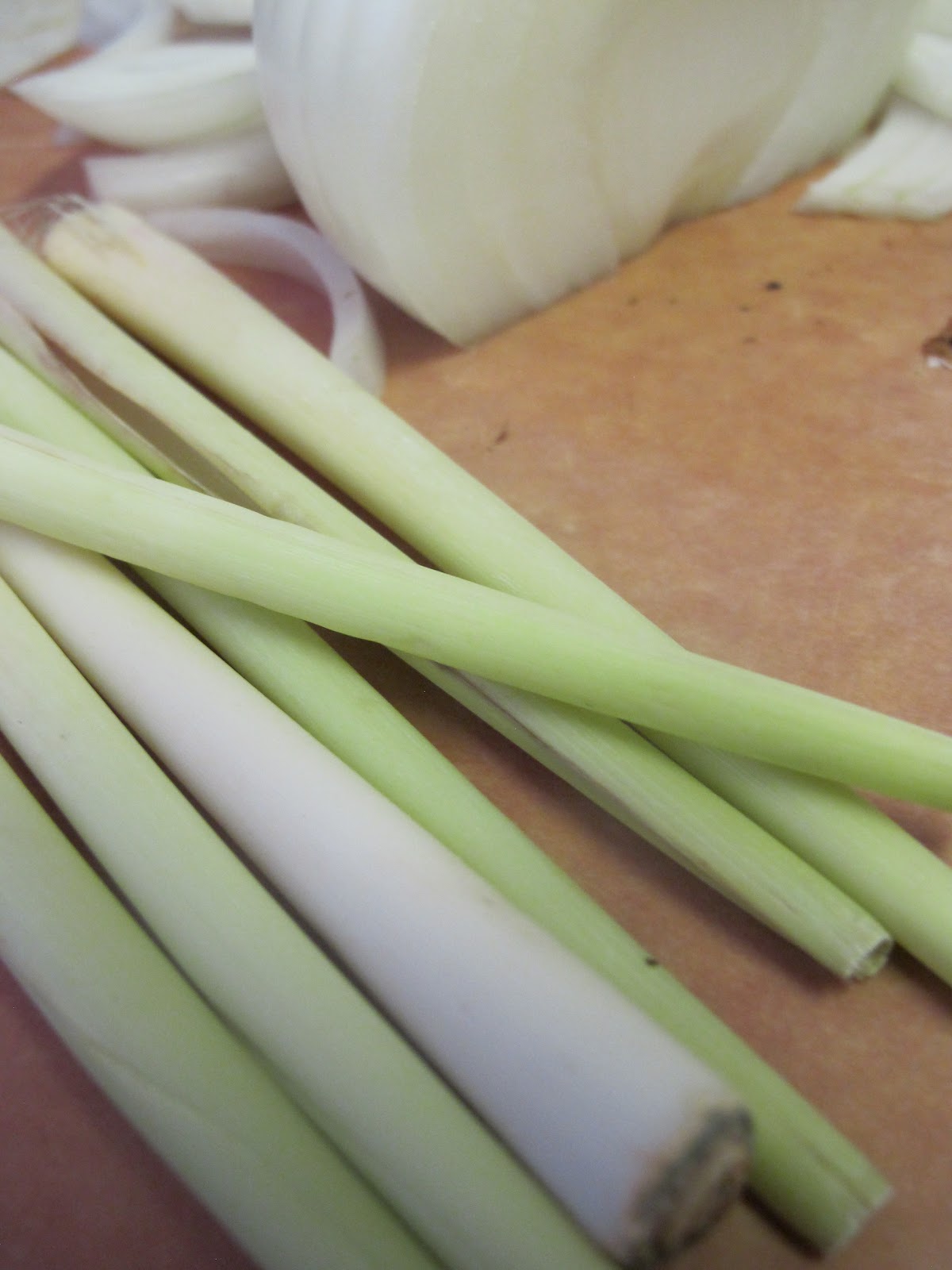
First, "dress" the lemon grass.  Peel the hard outer layers and cut off the dry green tips.  Take the soft white bases and crush with a knife.  Enjoy the delicious aroma of sweet, sweet, lemon grass.  In fact, rub some on your wrists, just for fun!

Heat the olive oil and saute the grass and onion for 3 minutes.  Add the spices and saute  for another 2-3 minutes.  Then add the remaining veggies.


Yes... I picked this sweet potato because it looked just like a Kamakura cookie!

Cook for another 2 minutes, then add the broth and water.  Bring to a boil, then reduce heat and simmer for 25 minutes.


Remove the lemongrass...or don't. I didn't.  However, when eating the soup, be careful not to eat the lemongrass.  It won't kill you put it's not pleasant to nom.

Add the peas and the coconut milk.  Cook 3 more minutes, then add the cilantro and serve.


Delicious and soooooooooooooo healthy!

Monday, June 25, 2012

Ahoy! Here Thar be Soy!

In researching my Dothraki wedding feast, I came to the conclusion that, statements of GRRM about composite cultures aside, I wanted to make Mongolian-esque food.

This of course required the use of Soy sauce.  But would that be proper? What exactly is this delightfully salty sauce and would a Dothraki Horde have access to it?

Answer: Yes.


The good folks over at the Kikkoman Soy Museum have put together a nice condensed history of soy sauce, but the take home point is that soy sauce (the American and British name derived from the Japanese term "Shoyu" or "Shio") is an ancient method that served the two very important purposes of both preserving perishable foods and enhancing the flavor in an economical and efficient manner given the high cost of pure salt.


For more on Salt, and the history of Salt, including a great discussion of the history of soy sauce and the many wars fought over the salt trades, I highly recommend this book.   All the salt and history you could ever want, and more!

Sunday, June 24, 2012

Dothraki Wedding Part 1

She had never seen so many people in one place, nor people so strange and frightening... They gorged themselves on horseflesh roasted with honey and peppers, drank themselves blind on fermented mare’s milk and Illyrio’s fine wines...Food was brought to her, steaming joints of meat and thick black sausages and Dothraki blood pies, and later fruits and sweetgrass stews and delicate pastries from the kitchens of Pentos, but she waved it all away.

My question...WHY???? Because that sounds pretty awesome.  Okay, so maybe I know why...the whole "being sold as a child bride by your creepy power hungry brother" thing probably doesn't do much for one's appetite, but still...

I've given a lot of thought to Dothraki cuisine and have come up with the following rules:


1. GRRM has said many times that the Dothraki are a composite of many cultures, including the Mongolians and various Native American cultures.  However, although there is not a direct one for one analogy, it is impossible to look at Khal Drogo and not see shades of Genghis Khan, so many of my Dothraki meals will have a Mongolian feel to them.  Mmmmmmm...Mongolian....

2. The Dothraki would likely have access to a wide variety of spices, ingredients, and culinary styles, borrowed from places that paid them tribute or...well...didn't pay them tribute and got their stuff taken anyway.  So there will be shades of middle eastern, far eastern, and basically anything that is good, meaty and hearty.

3. As a nomadic culture, the cooking methods must be simple.  There may be the ability to do things a little more complex while close to town, but this will largely be campfire and dutch oven cuisine.  Again...yum!

4.  "horseflesh" will be represented by either elk when I can get it, or very lean beef.  Horse are friends, not food.  And besides, in the US horse consumption is banned.

So, now that that is settled...without further ado...Part one of a multi-part series:

Horseflesh Roasted with honey and peppers!

  • one large, lean sirloin steak or elk steak.
  • 1/3 cup of soy sauce*
  • 2 tablespoons of white wine vinegar
  • 1/2 tsp crushed red pepper
  • 2 tsp ginger crushed
  • 2 tsp garlic
  • 1/3 cup honey 
  • Colorful Peppers
Cut the steak with the grain into 1/2 inch strips.  Combine the soy sauce, vinegar, pepper, ginger, and garlic.  Marinate in a shallow dish for 20 minutes.  Flip over, and marinate for another 20.

please ignore the fact this meat has been frozen...Dothraki meat would of course be steaming fresh off the horse!


Skewer the beef, weaving it with some cut up peppers.

Add the honey to the reserved marinate liquid and baste liberally.

Grill beef to your liking.  We did 3-4 minutes per side at medium high heat and ended up with "medium".

While the meat is grilling, boil the remaining marinate and honey until it reduces to a syrup for dipping.


I then served it over a bed of couscous with cinnamon, cardamom, and ginger.


*Stay posted for a discussion of soy sauce and how yes, indeed, your ancient recipie may in fact use your favorite salty condiment!

Thursday, June 21, 2012

Pondering the Dothraki, but for now...HAKA POWER!

I will be doing a more thorough post on my thoughts on the Dothraki, namely "are they just the Mongols, or something else?" but for now this is too cool not to post:

I KNEW IT WAS A HAKA!

That's right, Jason Momoa, HBO's "noble savage" got the part by performing a haka for the casting directors.


I knew the first time I saw that scene that Momoa had absolutely drawn inspiration for that scene from the haka.  Here's the official New Zealand and Tonga rugby versions:


And, since this is after all a cooking blog, the same..performed by gingerbread men:

Wednesday, June 20, 2012

Dinner in Pentos

 My fellow magisters have doubled the size of the city guard,’ Illyrio told them over platter’s of honey duck and orange snap peppers one night at the manse that had been Drogo’s. The khal had joined his khalasar, his estate given over to Daenerys and her brother until the wedding.”

Apologies for the delay in posting this, travel took me away from both the kitchen and the keyboard.  However, I hope this is worth the wait.  For Magister Illyrio's dinner, I decided a wealthy merchant would have access to all manner of spices and rich foods and, when dining with the potential future king whose royal butt he's been kissing, the dinner would be rich and succulent.

For the duck you will need:

  • One whole duck.  You can truss it if appearances matter, but most ducks cook up fine on their own.  I did not truss mine.
  • 1 tsp fresh crushed basil
  • 2 tsp ginger
  • 1 tsp sea salt
  • 1 orange cut into quarters
  • 6 bay leaves
  • 1 cup honey
  • 1/2 cup butter
  • 1 tsp fresh lemon juice
  • dried crushed tarragon to taste
Preheat oven to 350.  Mix basil, ginger and salt and sprinkle on inside and outside of duck. (NOTE THIS SHOULD GO WITHOUT SAYING...but if your duck came stuffed with its neck and liver, remove these!) Stuff duck with quartered orange and 4 of the bay leaves.  Sprinkle tarragon on top of the duck.  Lay in a roasting pan breast up, and fill pan with 2 cups of water.


In sauce pan, combine butter, honey, lemon juice and 2 bay leaves and simmer until it reduces to a syrupy consistency.  Pour half over the duck and save the rest for basting.

Cover and back for 30 min.  Remove, flip breast side down, baste and continue to roast covered at 300 for 2-2.5 hours.

Turn breast side up and uncovered for last 15 minutes, covering the breast with the remaining syrup.

As always, steal the skin while no one is looking and eat it yourself!


For the orange snap peppers, I simply sauteed some orange peppers and sugar snap peas in a blood orange infused olive oil with sea salt, orange slices, ginger and curry powder. until the peas were soft but still had a nice crunch.  These images are odd because apparently "rotate image" is just a suggestion.  So, enjoy sideways peppers!


In a later post, I will show you what to do with any delicious leftover duck, but for now...I think I like Pentos!


Monday, June 11, 2012

Free City States

GRRM has said many times that while there are some clear sources of inspiration (Hadrian's Wall, for example) much of his world is inspired by different sources and direct one to one comparisons are rare.  Still, there seems to be an obvious analogy between the Free Cities and the City States of Italy and, to help me narrow down my cooking styles and ingredients, this seems as good a parallel as any.  Life in the Free Cities seems a little more historically advanced than in Westeros, comparable to the earlier start of the Renaissance period in Italy, and its eventual spread to other parts of Europe.

One can't help read about the "Doom of Volantis" without thinking of Mount Vesuvius and the fate of Pompeii, (to be discussed in greater detail later), and High Valyrian, a language forced on the children of the highborn and spoken with bastardized accent elsewhere in the world seems reminiscent of Latin.  Imagine Arya trying desperately to flee her Septa while being drilled in the fact that Gaul was indeed divided into three parts!


The nine Free Cities are Lys, Myr, Pentos, Braavos, Lorath, Norvos, Qohor, Volantis and Tyrosh. They are independent city-states that lie across the narrow sea on the western side of Essos, mostly on islands or along the coast. Mountains to the east separate the coast from the plains of the Dothraki Sea, though gaps in the mountain range provide the Dothraki people some access to the Free Cities. The Free Cities were colonies built by the ancient Valyrian Freehold, and later declared independence after the Doom of Valyria.  Similarly, the first Italian city-states appeared in northern Italy as a result of a struggle to gain independence from the  Holy Roman Empire. The Lombard League was an alliance formed around 1167, which at its apex included most of the cities of northern Italy.  Around 1100, Genoa and Venice emerged as independent Maritime republics. For Genoa the Holy Roman Emperor was overlord and the Bishop of Genoa was president of the city; however, actual power was wielded by a number of consuls annually elected by popular assembly. Pisa and Amalfi also emerged as maritime republics: trade, shipbuilding and banking helped support their powerful navies in the Mediterranean in those medieval centuries.

Between the 12th and 13th centuries, Italy was vastly different from feudal Europe north of the Alps. The Peninsula was a melange of political and cultural elements rather than a unified state. The very mountainous nature of Italy's landscape was a barrier to effective inter-city communication. The Po plain however, was an exception: it was the only large contiguous area, and most city states that fell to invasion were located there. Those that survived the longest were in the more rugged regions, such as Florence or Venice, which was protected by its lagoon. The rugged terrain of the Alps prevented the German Princes from attacking Northern Italy, safeguarding the country from German political control. Largely for these reasons, no strong monarchies emerged as they did in the rest of Europe; instead there emerged the independent city-state.
While those Roman, urban, republican sensibilities persisted, there were many movements and changes afoot. Italy first felt the changes in Europe from the 11th to the 13th centuries. Most notably, the city states developed as centers for urban life, commerce, and the re-emergence of the religious cathedral.

In recent writing on the city states, American scholar Rodney Stark emphasizes that they married responsive government, Christianity and the birth of capitalism. He argues that these states were mostly republics unlike the great European monarchies of France and Spain with absolute power vested in rulers who could and did stifle commerce. Keeping both direct Church control and imperial power at arms length the independent city republics prospered through commerce based on early capitalist principles ultimately creating the conditions for the artistic and intellectual changes produced by the Renaissance.

So what about Pentos?


Pentos is one of the Free Cities. It is a port located on the western coast of Essos. Pentos is a large port city, more populous than Astapor on Slaver's Bay, and may be one of the most populous of the Free Cities. It lies on a bay off the narrow sea, with the Flatlands plains and Velvet Hills to the east.  The city has many square brick towers, controlled by the spice traders. Most of the roofing is done in tiles. There is a large red temple in Pentos, and the 'Sunrise Gate' allows the traveler to exit the city to the east, in the direction of the Rhoyne. Pentos is a city where wealth equals power, ruled over by a prince with a council of magisters. The prince has a mostly ceremonial function while the rich magisters rule.  The prince is chosen from the forty families, and presides chiefly over balls and feasts. Three heralds travel with him: the golden scales of trade, the iron sword of war and the silver scourge of justice. On the first day of every new year, the Prince must deflower the maid of the fields and the maid of the seas. When the Pentoshi believe the gods are angry at them, such as after loss in a war or a crop failure, they sacrifice the prince by cutting his throat to appease the gods and then choose a new prince from amongst the forty families. The city survives largely by paying tribute to the Dothraki, and trying not to anger Braavos.

Which sounds like GRRM may have stolen the idea from these guys: (shiny nickel to anyone who remembers that reference!)


So, taking all of that into account, in my mind, Pentos = Pisa.  For starters, they both begin with a P.  Why not?  Second, like Pentos, Pisa is a commerce center on the northwestern coast or Italy.  Throughout much of its history, Pisa was sacked by various enemies including Vikings, Byzantines and Saracens.  No Dothraki mentioned...but enough other invaders to establish it as a vulnerable locale.  Pisa was a great sea power, credited with the invention of the battering ram (for when you really want to tell that other ship you don't like it) and was a leader in maritime trade.  The perfect home for a Magister cheese monger!


Why this is important is tonight I am making Pentoshi Duck! More to follow!