Sunday, June 10, 2012

Breakfast for Tyrion

I'm probably not alone in thinking that Tyrion Lannister is the embodiment of awesome.  One of my favorite lines of dialogue from season one, and one of the earliest food references in the books comes just after Tyrion gives Joffrey that well-deserved backhand to the face.

Tired from a hard morning of slapping the crowned prince, he enters Winterfell and orders himself up a nice hearty breakfast.

"Bread! And two of those little fishes.  And a mug of dark beer to wash it down.  And bacon, burn it until it turns black."

I see nothing in this plan I don't like.  Largely because It gives me an excuse to a. drink beer with breakfast and b.  bacon.

For the bread, pumpernickel seemed most fitting.  Dark, hearty, delicious.  I will eventually post some more thorough thoughts on breads and starters and, gods willing, may even be venturing into the realm of beer mash leavening, but for now,I cheated and made a nice dark loaf with dry quick rise yeast.  Sacrilege, I know.

I used rye flour and added 2 tablespoons of cocoa powder and 2 tablespoons of molasses for color and it was wonderful.

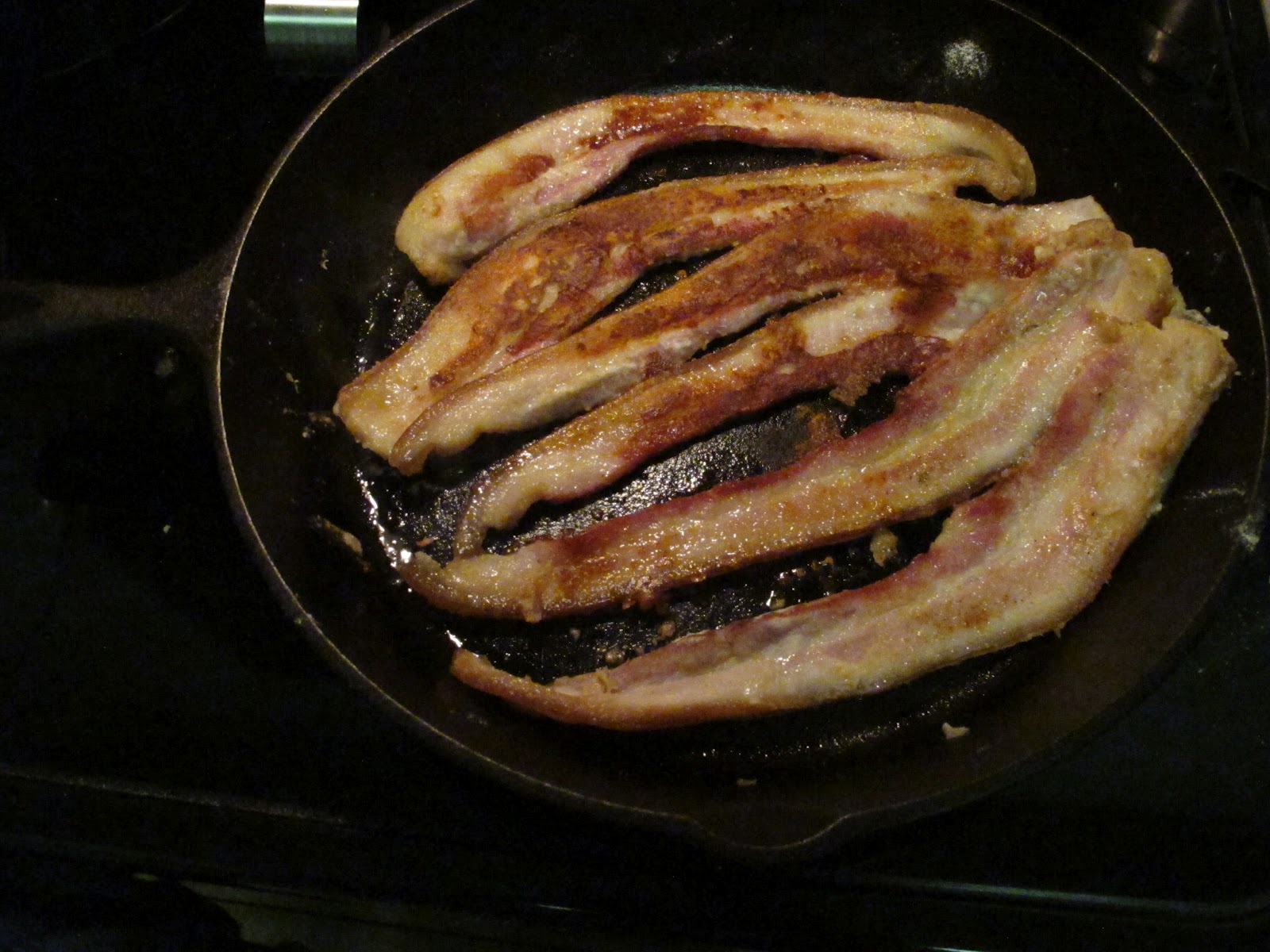
For the bacon, I used our local butcher and got some delightfully thick slices.  I'm not a huge fan of burnt bacon, as I like the taste of bacon, not char, but I do like the crispiness, so I roll my bacon in a little bit of flour before frying.  It soaks in the juices nicely.
Mmmmm...bacon

 As for the little fishes, this to me screamed "smelt fried in bacon grease".  This sounds gross but is actually quite tasty.  I purchased my smelt already dressed, but if you have the time and inclination, they are fairly simple to gut.  Simply slice below the neck and slice open the belly to gut.  As a general rule, fish under 2 inches long do not need to be gutted at all. And leave the heads on if you are feeling particularly adventurous.  I made a quick batter by dipping my smelt in a whisked egg and rolling them in flour, then fried them in the bacon grease for about 2 minutes each side.  A small dish of salt and black pepper makes for a nice dipping plate.


Finally, for the dark beer, I went with Harvestoun Old Engine Oil black ale.  It's thick but not too heavy, and has a nice, mildly sweet creamy taste.  And finally, a nice wedge of hard cheese.  This one was an aged sheep's milk.  


All in all, a breakfast fit for an imp!


Saturday, June 9, 2012


Lunch Along the Kingsroad

It was a day for adventures.  They explored the caves by the riverbank, and tracked a shadowcat to its lair. And when they grew hungry, Joffrey found a holdfast by its smoke and told them to fetch food and wine for their prince and his lady.  They dined on trout fresh from the river and Sansa drank more wine than she had ever drunk before.

And then of course there was that whole "unprovoked sadism followed by getting bested by a nine year old girl" thing...


I don't generally care about the food Joffrey eats, unless it's food he's choking on.  But this sounded rather tasty.

First take a cedar plank and soak it for about 2 hours.  Then take two trout fillets and baste them with olive oil, rock salt, black pepper and some dried tarragon.

Grill over indirect heat on medium high heat for about 20 minutes or until fish is flaky.

Serve with wine...of course.


Now if only that holdfast had paid less attention deboning that trout...

Friday, June 8, 2012

Sugar, doo doo doo doo doot do, oh honey honey...

I'll be getting more into the foods of the books in due time, but today seems as good a time as ever to discuss a topic near and dear to everyone's heart: What about dessert?

Before getting to far afield with lemon tarts and the delicate pastries of Pentos, it's important to recognize that something that's fairly common in modern kitchens, sugar, would have been quite a luxury in a Medieval kitchen, or even a Renaissance kitchen (It's hard to tell exactly "when" the world of Westeros is and, like most fantasy, this world seems to blend a little of this and that).

Originally, people of India chewed sugarcane to extract its sweetness.  Then, around 350 AD, some great people learned that it could be boiled into a syrup and then solidified into an easy to transport, preservable crystalline form.

Shortly thereafter, sugar made its way to China and the Middle East.

There are records of knowledge of sugar among the ancient Greeks and Romans, but only as an imported medicine, and not as a food.  In particular, the "honey like salt" was thought to alleviate kidney and bladder pain. During the Muslim Agricultural Revolution, Arab merchants adopted the sugar refinement techniques of India and transformed them into large scale operation.  The conquests of the Iberian peninsula brought sugar to Europe in the 8th century, and more sugar was introduced when Crusaders encountered caravans carrying "sweet salt" and brought it home.

By the 12th century, Venice began to farm sugar plantations for export to Europe.  So, of course sugar would be available in Westeros, likely shipped in from across the Narrow Sea where it's traders could rely on slave labor, but like many things we take for granted, it too would be a luxury.

Honey, sugar beets, maple syrup and other more local sweeteners would be used by the small folk, but for special occasions, even Ned Stark might allow a little bit of sweet.

So, with that said, here is a delightful cake that might have found itself a home in the kitchens of Winterfell.  (Note, baking soda absolutely would NOT have been available, so this cake omits any baking soda or other leaveners.  For a lighter, less accurate cake add 1.5 tsp of baking soda)

Winterfell Cake

  1. 1/2 cup of cooking oil (I used vegetable) 
  2. 2 cups flour
  3. 2 tsp cinnamon
  4. .5 tsp cloves
  5. .5 tsp salt
  6. 1/2 cup honey
  7. 1/2 cup packed brown sugar
  8. 1 egg
  9. 1 tsp ground ginger
  10. 1 apple, chopped (I used a Macintosh, because it was there, but in a perfect world, use a granny smith)

Heat oven to 350.  Oil a round cake pan and dust with flour. EDIT: An astute reader has called me out.  Lard would have been more likely used instead of oil.  However, in a lot of my desserts especially, I will be trying to a. not give my husband a heart attack and b. keep things that don't NEED to involve animal products vegetarian friendly to balance out the barrage of meat fests!  So veggie oil it is!

In a large bowl, whisk flour, cinnamon, cloves, and salt (and baking powder if you are a cheater...)  In a medium bowl whisk oil, honey, sugar, egg, ginger and 1/2 cup boiling water.  Add to dry ingredients and whisk until combined.  Do not over whisk.  Fold in apples.  I added some more cinnamon on top because cinnamon is delicious.


Transfer to pan and bake 40-45  minutes until a toothpick comes out clean. Cool in pan for 30 min, then turn onto a rack to cool completely.  You can dust with some confectioners sugar if you like, but I don't think Ned Stark would approve.  Serve with milk, or a nice winter stout.

Thursday, June 7, 2012

Honeyed Chicken and Roast Onions

 “‘Hungry again?’ he asked.  There was still half a honeyed chicken in the center of the table.  Jon reached out to tear off a leg, then had a better idea.  He knifed the bird whole and let the carcass slide to the floor between his legs.  Ghost ripped into it in savage silence.”

Our first mention of food is the feast prepared upon King Robert's arrival at Winterfell.  Not much of the food is mentioned, save for two dishes: Honeyed Chicken and Roast Onions.  (And of course trenchers...but what else is new?) I figured this would be an easy first venture.

First, I decided that the kitchen of Ned Stark would be simple, frugal, and prone to reusing ingredients.  However, this was a feast for a king, so some extravagances would be allowed.  Lemons were cultivated on a large scale in Genoa as early as the 15th century and, while it would be difficult to raise lemons in the North, King's Landing seems to have no shortage of them, and regions of Dorn are similarly known for their lemons.  With a caravan traveling from King's Landing, it's not difficult to imagine some traders and merchants would tag along for safety, and lemons may be just the type of practical luxury a man like Ned Stark would spring for.  So our honeyed chicken will feature lemons.

For the honeyed chicken you will need:
  1. Rosemary Sprigs.  A lot of them.  Lucky for me I have a garden in which about the only thing that actually grows is rosemary.
  2. One chicken.
  3. 1/2 cup olive oil 
  4. 1/4 cup fresh lemon juice
  5. 4 tablespoons honey
  6. One sliced lemon
  7. 4 shallots (peeled)
  8. Sea Salt and Black Pepper to taste.
Preheat the oven to 375.  Line a roasting dish or dutch oven (I used a dutch oven) with 3/4 of your rosemary.  Put chicken on top.

Whisk the oil, lemon juice and honey in a small bowl to blend.  Lift the skin away from the chicken breast and rub 1/4 of the mix into the meat.  Careful, don't break the skin.  Drizzle the remainder over the chicken and stuff with half a lemon, one shallot, and some more rosemary.


Tower to honey sauce, you are clear for landing.

 Season chicken with salt and pepper to taste and surround with shallots.  Top with lemon slices and more rosemary.

Happy Chicken is happy.


Roast chicken, basting frequently for one hour.  Increase temperature to 425 and finish roasting until skin is golden and crispy.

Finally, remove chicken from pot and steal all the skin while no one is looking.  OMNOMNOMNOMNOM.

For the onions, peel two onions and cut in half, crosswise. Place in a dish, cut side down, sprinkle with water and bake covered at 350 for 30 minutes.

Mix together 1/4 cup of honey, 1 tablespoon of melted butter, salt and pepper to taste, and a teaspoon of dried rosemary.  Flip the onions over and baste with 1/2 of the mixture.  Bake for an additional 30 minutes, uncovered.  At 15 minutes, cover with the remaining honey sauce.


When all was done, the chicken was tender and succulent, but the honey taste was more subtle than I had hoped.  I imagine that would be cured by taking some of the pan juices, combining with another 1/4 cup of honey and reducing to a nice honey glaze but a. that is more calories than I wanted in this meal and b. I didn't want to wait to eat my wonderful smelling chicken.

The onions had a delightfully sweet taste and a nice crunch, but did not want to hold together.  It's hard to imagine Benjen Stark managing to pick them up without the aid of a fork, but their juices were delightfully runny, so I guess we can just assume Benjen is a man who doesn't mind getting his hands dirty when he eats.

One and A Half Man: Tuesdays on ABC

This has nothing to do with food, eating, feasting, or trenchers, but it's too funny not to post.

The sad thing is...I kind of wish this was real.


Wednesday, June 6, 2012

Some Thoughts on Trenchers

Seems we can't swing a dead direwolf without running into a reference to trenchers.  My husband was pleased with this, as it meant, in his mind, lots of delicious bread bowls drenched in soppy goodness.

Not true, unfortunately.  The "trencher", from the French "tranchier" (to cut) was less a bread and more a form of tableware.  Eventually replaced by wood, stone, or metal plates, the trencher was a square slab of stale bread.  By most historical accounts, the best trencher was half a foot wide and four inches tall.


Rarely did people eat their own trencher.  The bread was stale and made of particularly coarse flour to ensure it was tough enough for it's intended purpose.  Most bakers had distinct recepies for table bread and trencher bread.  In fact, the term "trencherman" was often used to describe a person who ate or drank to excess.  The trenchers were more often either tossed to the more prized hounds (a trencher fed pack) or gathered up as alms for the poor.  OMNOMNOM! Leftovers!


For those interested in the history governemnt regulation of private industry, one of the first laws to regulate the production and sale of food was the Assize of Bread and Ale, enacted by Henry III in 1267. The law tied the price of bread to the price of wheat to limit a baker's ability to inflate the price of bread. Similarly, the price of ale was tied to the price of wheat, barley and oats. Beer and ale was regulated by gustatores cervisiae, or ale-conners, appointed “to examine and assay the beer and ale, and to take care that they were good and wholesome, and sold at proper prices according to the assize.“

The Assize of Bread and Ale remained in effect until the mid 19th century.  A shame, because that sounds like a pretty awesome job.

Trenchers made perhaps their first literary appearance in Virgil's Aeneid.  In book 3, Aeneas recounts to Dido that the Chief of the Harpies made a prophesy in which he would arrive in Italy but...

Never shall you build your promised city
Until the injury you did us by this slaughter
Has brought you to a hunger so cruel
That you gnaw your very tables.
The prophecy is fulfilled in book 7, when the Trojans eat their trenchers. Aeneas states:

I now can tell you, my father Anchises
Revealed these secrets to me for he said:
"When you have sailed, son, to an unknown shore
And, short of food, are driven to eat your tables,
Then, weary though you are, hope you are home


After much thought, I have decided to deviate from coarse stale bread and go with the more modern "bread bowl" for several reasons, the most compelling of which is that I have been unable to find a local shelter willing to take stale bread with leftover food bits on it.  More to follow.